Description:
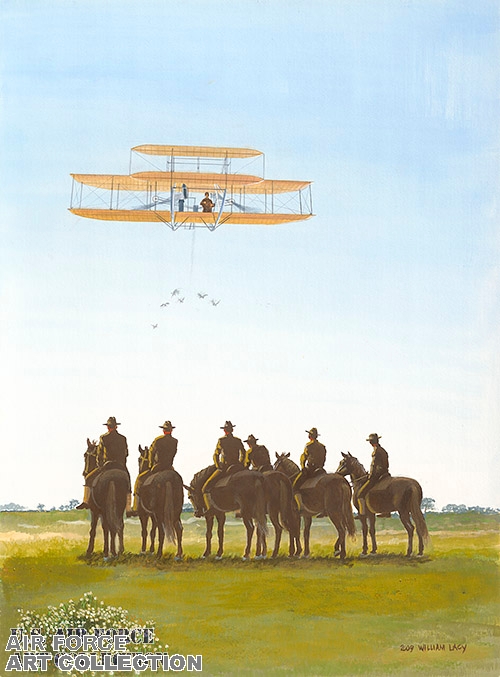
Out with the old in with the new. Soldiers on horseback look at Wright Flyer overhead.
Assembly of a maneuver division at Fort Sam Houston in 1911 enabled the Army to experiment with new systems and procedures. These new “high technology” systems included machine guns, wireless telegraph, field telephones, and aircraft. During the Maneuver Camp, the Army activated its first provisional aero squadron with Lt. Paul Beck as commander. The squadron was formed to determine the capabilities and limitations of aircraft, identify tactical roles which aircraft could support, and train additional aviators. On May 10, 1911, Lt George Kelly (for whom Kelly Field was named) was killed in an aviation accident; and on May 15th, Major General William Carter, the Commanding Officer, prohibited any further flying from the drill ground, ending aircraft operations. The aircraft returned to College Park, Maryland. Though flying operations with the Maneuver Division ended on a negative note; the usefulness of aircraft, still technically unsophisticated, for reconnaissance and liaison had been successfully demonstrated. Mr. Robert F. Collier, famed publisher and owner of Collier’s Weekly Magazine, loaned the Army his Wright B Flyer. He also sent Mr. Jimmy Hare, a noted war photographer, to photograph the Army’s use of his aircraft. This painting is based on one of Mr. Hare’s photographs taken during the Maneuver Camp in and around Fort Sam Houston.
|